

Blocking Burnham: the latest salvo in Labour’s assault on democracy

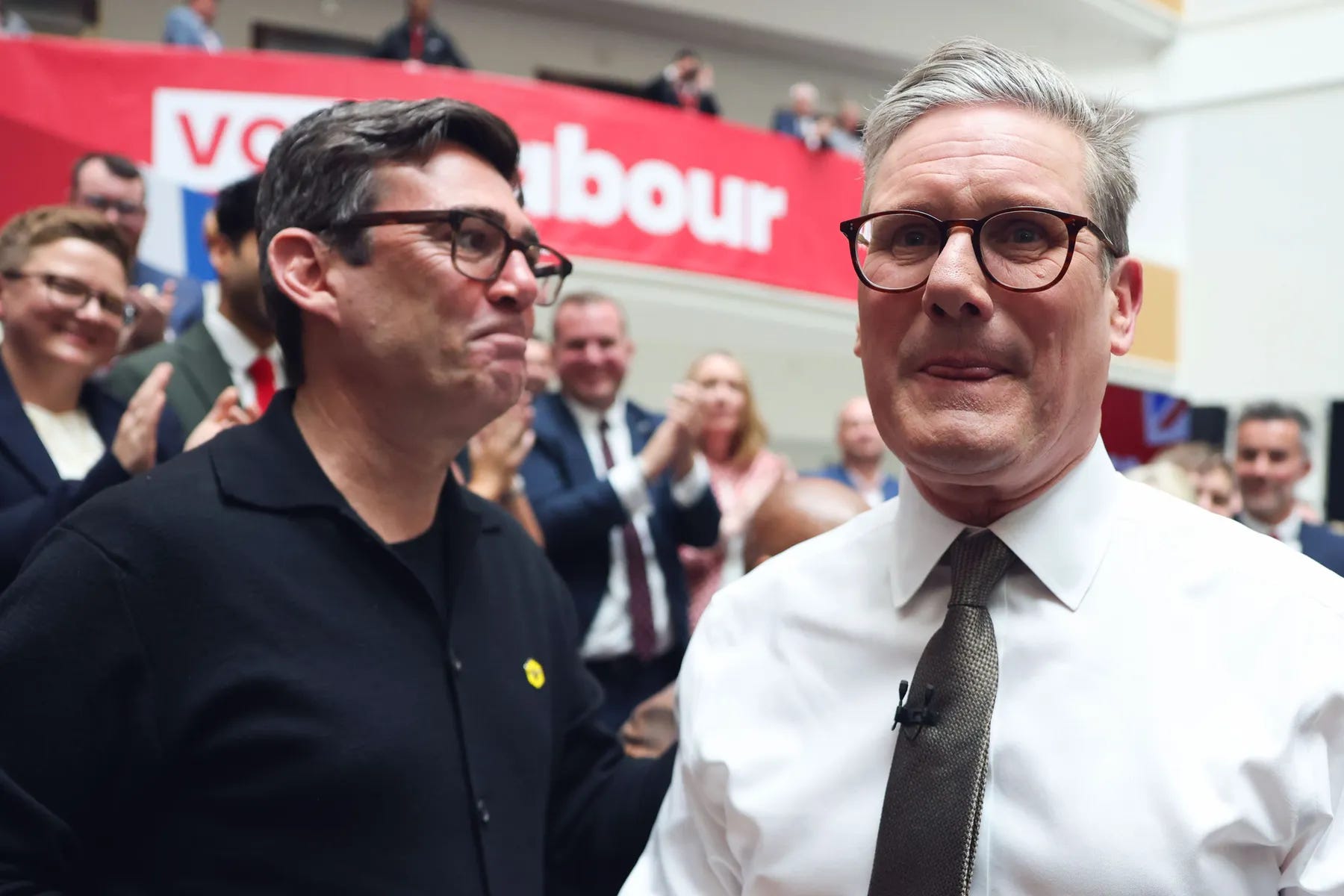
Last weekend Labour’s National Executive Committee (NEC) blocked Andy Burnham from standing in an upcoming election. Much ink has been spilled about this “by-election bust-up”, far less about the pattern of anti-democratic decisions that paved the way to it.
Cancelled elections, disproportionate outcomes, and internal stitch-ups: British democracy is in a sorry state, and it’s the right-wing clique atop the Labour Party who stand to benefit. At least in the short term. This article situates their decision to block Burnham within Prime Minister Keir Starmer’s broader authoritarian turn.
Postponed council elections
Labour’s choice to block Burnham makes sense when you realise they view winning votes as a bureaucratic inconvenience. They are simply not interested in representing you, as demonstrated by the recent uptick in Labour MPs baselessly reporting tenacious constituents to the police.
Labour, who promised to end austerity, recently invited councils to “raise capacity concerns and seek to postpone elections.” That is, to cancel elections because they cost too much.
Twenty-nine councils accepted the government’s offer, leaving over four million voters without a say. Still more are threatening to do so. Most wanting a delay are Labour-led. This is convenient since polls indicated they were set to lose badly before they called the whole thing off.
First-past-the-post voting
Consistent with his disregard for voter opinion, Starmer has abandoned his former support for electoral reform. It’s not difficult to work out why. The distortions of our first-past-the-post (FPTP) voting system let him win by getting fewer votes than Labour did in 2019, a result that Starmer called a “devastating loss” at the time.
First past the post often struggles to turn votes into representative parliaments. However, its distortions were especially stark in the last election. A record six in ten voters did not get the MP they voted for. A vote for Labour was thirty five times more powerful than a vote for smaller parties like Reform.
The line Labour have settled on to defend this unfairness is that wanting a fair voting system makes us sore losers (“people complain about FPTP – but everyone knew the rules”) and hypocrites (“Strangely, I do not remember much debate in 2015 about whether Cameron had truly won the election”).
The truth meanwhile, is that Starmer’s Labour Party is simply not interested in fair elections. Their strategic wager is that, if they can turn the next election into a starkly binary choice, we’ll all come crawling back to them. A key cabinet member recently admitted as much:
The real fight will be the centre-left versus the Reform right.
And Home Secretary Shabana Mahmood recently reiterated this threat:
If you don’t like this, you won’t like what follows me.
Her pitch to voters is that the only way to avoid getting what they really don’t want, is to vote for something else that they also don’t want. This is why Labour oppose proportional representation against the stated wishes of MPs, the general public, and Labour delegates. It’s a protection racket, and a dangerous game for a party polling in fourth place to be playing.
Internal stitch-ups
Andy Burnham beats all other Labour figures on approval ratings. This is because he seems warm and relatable, not managerial or rehearsed. His approval rating is 52% higher than Starmer’s, and constituency polling shows that Labour win this seat with Burnham as their candidate and lose without him.
The party is not ignorant to this. Senior Labour figures have privately conceded that they expect to lose. Thus, blocking Burnham from standing signals a leadership prepared to risk defeat rather than tolerate a victory by someone outside its faction. Mark it on the calendar. Sunday 25th January, 2026. The date the Labour Party called it a day.
For Starmer’s clique, victory is secondary to retaining control of the party. They’ve re-written the Labour Party rulebook to stymie Burnham and people like him. Changes include a new clause nicknamed the “Burnham clause”:
Directly elected mayors … must seek the express permission of the National Executive Committee of the Labour Party … before seeking nomination as Labour candidates for the Westminster parliament.
You must be an MP in order to run for the leadership of the Labour Party, so the NEC used this rule to deny Burnham’s run before it began.
Other avenues of skulduggery floated by Starmer allies included declaring an all-BAME (black and minority ethnic) or all-female shortlist of candidates. This way they could block Burnham without being seen to single him out. The plan was to take a tool meant to fix structural inequality and cynically repurpose it as a factional weapon.
Starmer’s faction have been doing this kind of thing for years. For example, in the Corbyn years, Starmerite staffers misused the party’s disciplinary systems. Tasked with rooting out bigotry, they instead used their position to systematically “hunt” and expel “Trots” (short for Trotskyite: a derogatory term for left-wingers).
Starmerites are systematically dismantling Labour party democracy. They promised to “link up our mass membership, unite our party and promote pluralism.” However, they’ve now stopped members from debating some issues. It’s also harder for members to nominate future leaders or deselect MPs. They even went so far as to clarify that:
the principle of natural justice shall not apply to the termination of Party membership.
Keir Starmer claims he puts the country first, but he seems like a local control freak. His plan is to crash the plane. His bet is that, when the wreckage stops, someone from his faction will still be in the pilot’s seat.
I could go on but I think you get the idea. This party does not respect your vote and will not listen to your concerns.
Acknowledgements
This article paraphrases compelling metaphors and astute observations made by @OfSymbols & @flying_rodent on twitter dot com.